When you first start crocheting, patterns can feel intimidating — especially when symbols and charts start showing up. If you’re completely new and not sure where to begin, start with my Start Here beginner guide.
You might wonder: Do I need to memorize all of this? Or Where do I even start?
The good news is: as a beginner, you don’t need to understand everything at once. Most early crochet projects rely on a very small set of stitches and symbols. Most beginner projects start with just the foundation chain and single crochet.
This guide is here to help you recognize the most common crochet symbols — just enough to start reading basic patterns and charts with confidence.
Crochet Chart Symbols: What Beginners Actually Need to Know
As a beginner, you don’t need to memorize all of these. Most first projects start with just chain stitch and single crochet.
🧶 Basic Crochet Stitches (Beginner Reference Table)
| Stitch Name | Chart Symbol (Simplified) | Abbreviation | What It Looks Like | Width (st) | Relative Height |
|---|---|---|---|---|---|
| Chain Stitch | ○ | ch | Foundation chain loops | 1 | Very short |
| Slip Stitch | • / — | sl st | Flat stitch used to join or move | 1 | Very short |
| Single Crochet | ✕ / + | sc | Tight, compact stitch | 1 | Short |
| Half Double Crochet | T | hdc | Medium-height stitch | 1 | Medium |
| Double Crochet | T with 1 bar | dc | Tall, open stitch | 1 | Tall |
| Treble Crochet | T with 2 bars | tr | Very tall stitch | 1 | Very tall |
| Double Treble Crochet | T with 3 bars | dtr | Extra-tall decorative stitch | 1 | Extra tall |
| Quadruple Treble Crochet | T with 4 bars | qtr | Rare, dramatic tall stitch | 1 | Extreme |
Note:
“Width” means how many stitches the stitch takes across.
“Height” shows how tall the stitch is compared to a single crochet.
Taller stitches create looser, more open fabric.
➕ Crochet Increases (Beginner Reference Table)
| Stitch Used | Worked Into One Stitch | Chart Symbol | Common Abbreviation | What It Does | New Stitches Made |
|---|---|---|---|---|---|
| Single Crochet | 2 sc in same stitch | V | inc / sc inc | Gently widens the fabric | +1 stitch |
| Single Crochet | 3 sc in same stitch | W | 3 sc inc | Wider, faster expansion | +2 stitches |
| Half Double Crochet | 2 hdc in same stitch | V | hdc inc | Adds width with medium height | +1 stitch |
| Half Double Crochet | 3 hdc in same stitch | W | 3 hdc inc | Thicker, more visible shaping | +2 stitches |
| Double Crochet | 2 dc in same stitch | V | dc inc | Widens tall, open fabric | +1 stitch |
| Double Crochet | 3 dc in same stitch | W | 3 dc inc | Strong, dramatic expansion | +2 stitches |
➖ Crochet Decreases (Beginner Reference Table)
| Stitch Used | Worked Together | Chart Symbol | Common Abbreviation | What It Does | Result |
|---|---|---|---|---|---|
| Single Crochet | 2 stitches together | ∧ | sc2tog / dec | Gently narrows the fabric | 2 → 1 stitch |
| Single Crochet | 3 stitches together | ∧ | sc3tog | Faster narrowing | 3 → 1 stitch |
| Half Double Crochet | 2 stitches together | ∧ | hdc2tog | Medium-height decrease | 2 → 1 stitch |
| Half Double Crochet | 3 stitches together | ∧ | hdc3tog | Stronger shaping | 3 → 1 stitch |
| Double Crochet | 2 stitches together | ∧ | dc2tog | Tall stitch decrease | 2 → 1 stitch |
| Double Crochet | 3 stitches together | ∧ | dc3tog | Sharper taper | 3 → 1 stitch |
For beginners, understanding these three tables is more than enough to read most basic crochet charts. If you want to practice these stitches in context, a simple project like a mini crochet scarf is a great next step.
You don’t need to memorize everything.
Once you can recognize basic stitches, increases, and decreases, most beginner patterns will start to make sense.
How Crochet Patterns Are Shown: Written vs Charted
In crochet, patterns are usually shown in two main ways:
written instructions and chart symbols.
Both are common, and neither is “better” — they just work differently.
Written Instructions (Text Patterns)
Written patterns use words and abbreviations to tell you what to do, step by step.
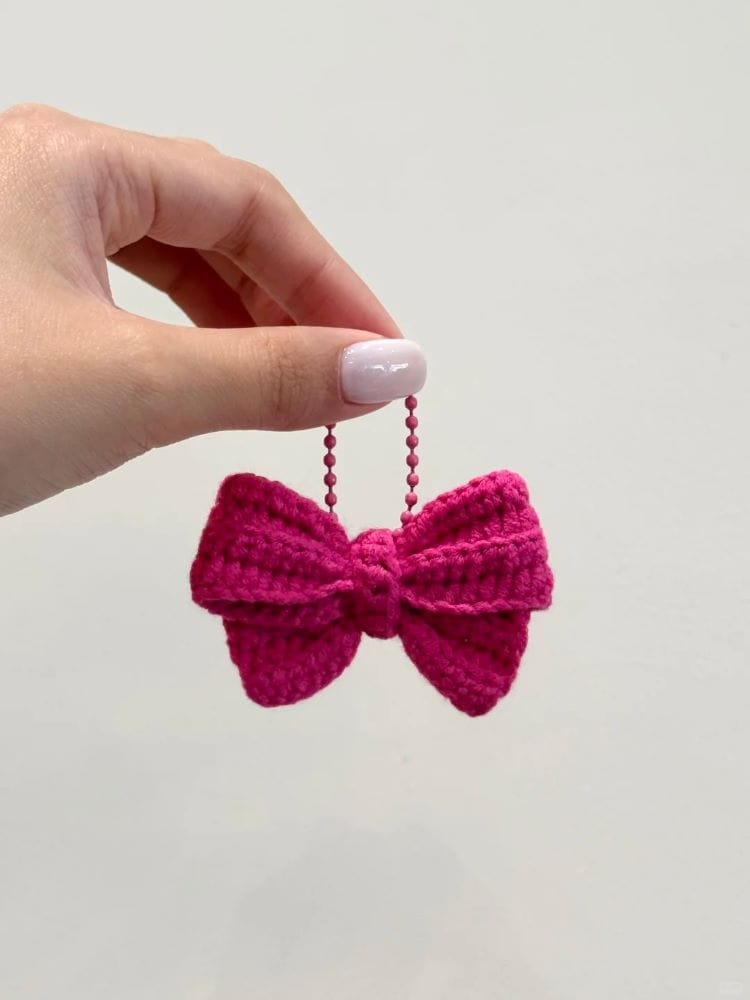
For example:
🧶Bow Crochet Pattern
Abbreviations
- ch = chain
- sl st = slip stitch
- dc = double crochet
- R = row
Main Bow Piece
R1:
Chain 63.
Starting in the second chain from the hook, work:
6 dc,
6 sl st,
16 dc,
6 sl st,
16 dc,
6 sl st,
6 dc.Turn.
R2–R4:
Repeat the same stitch pattern across:
6 dc,
6 sl st,
16 dc,
6 sl st,
16 dc,
6 sl st,
6 dc.Fasten off after Row 4.
Center Wrap (Bow Middle)
Chain 11.
Starting in the second chain from the hook, work 10 dc across.Fasten off, then wrap this piece tightly around the center of the bow and secure.
🧶 Bow Pattern (With Simple Explanations)
R1
Chain 63
(This creates the full width of the bow.)Starting from the second chain from the hook:
- 6 dc
(Forms the left outer part of the bow.)- 6 sl
(Pulls the fabric inward to start shaping.)- 16 dc
(Creates the wide middle section.)- 6 sl
(Narrows the fabric again at the center.)- 16 dc
(Mirrors the previous wide section.)- 6 sl
(Creates the final pinch point.)- 6 dc
(Forms the right outer edge of the bow.)Turn
(Flip your work to begin the next row.)R2–R4
6 dc, 6 sl, 16 dc, 6 sl, 16 dc, 6 sl, 6 dc
(Repeat the same stitch pattern to add thickness without changing the shape.)Center Strip
Chain 11
(This will wrap around the center of the bow.)Starting from the second chain from the hook:
- 10 dc
(Creates a firm strip to hold the bow shape.)Fasten off and wrap around the center.
If double crochet still feels unfamiliar, you may want to review the basics first.
If you’re just starting out, written instructions often feel more familiar because they read like directions. You move from left to right, row by row, and follow the words in order.
Most beginner patterns start with written instructions, and many projects include only text — no symbols at all.
Chart Symbols (Crochet Charts)
Charted patterns use symbols and diagrams instead of full sentences.
Each symbol represents a stitch, and the layout shows where stitches go in relation to each other. Charts are especially common for:
- Granny squares
- Motifs
- Shaping and repeats
- Visual learners
At first, charts can look overwhelming. But once you recognize a few basic symbols — stitches, increases, and decreases — the chart starts to read like a picture instead of a puzzle.
Which One Should You Learn First?
If you’re a beginner, it’s completely okay to start with written patterns only.
You don’t need to master charts right away.
Once you’re familiar with basic stitches, increases, and decreases, chart symbols become much easier to understand — especially for projects with repeated shapes.
Many crocheters eventually use both, switching depending on the project.
A Simple Way to Think About It
- Written patterns tell you what to do, step by step
- Chart patterns show you what the stitches look like and where they go
Knowing that these are just two ways of explaining the same thing can take a lot of pressure off.
You don’t need to learn everything at once — just enough to keep moving forward.